


She was only fifteen when the man her sister loved turned her life into a nightmare.
Today, as Shaquawn “IsWe Boss” Alleyne faces trial, we revisit a story not just of murder — but of fear, grooming, and survival in Linden.
By Gtmemoirs Staff Writer | Linden, Guyana — November 2025
When news broke in April 2021 that 20-year-old Shonette “Dovie” Dover had been found buried in a shallow grave behind her boyfriend’s home in Canvas City, Linden, it shocked the nation. The revelation that her own 15-year-old sister had helped to conceal the body tore through the community with an even sharper sting.
Headlines screamed murder and betrayal. Social media turned courtroom. The public wanted justice, and they wanted it immediately.
But lost in the noise was a quieter, more painful story — one about power, fear, and the grooming of a child who became both witness and participant in an unthinkable act.
A Murder that Shook Linden
According to police reports, Shaquawn “IsWe Boss” Alleyne, then 21, told investigators that he “was cleaning his gun when it went off and shot Dovie.” He claimed it was an accident. In his confession, Alleyne admitted that in panic, he buried her in his backyard, with the help of Dover’s teenage sister.
Investigators later confirmed that the younger girl, only 15 at the time, led police to the site where Shonette’s decomposing body was found sitting upright in a shallow grave. The child confessed to witnessing the shooting and helping to hide the body.
For weeks, the two joined the search parties — pretending to look for the very woman they both knew lay dead just a few feet away.
By the time Alleyne fled the country, the story had already taken root in Linden’s collective imagination: a jealous sister, a forbidden love affair, a crime of passion.
But was that really what happened?
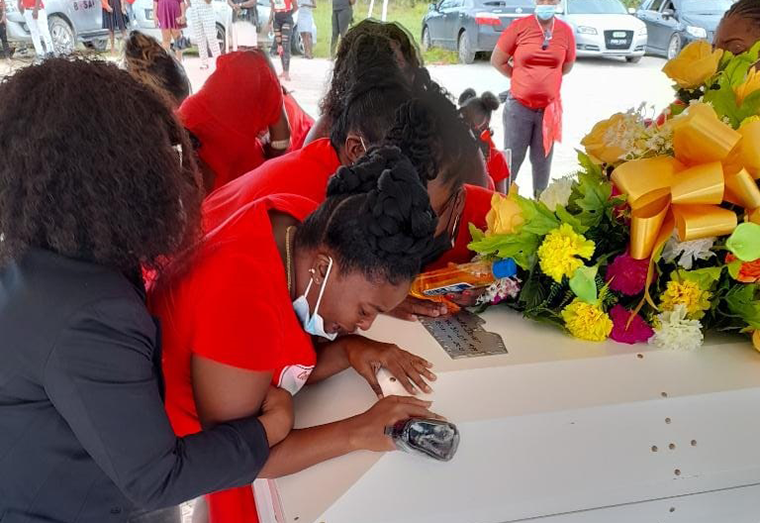
The Other Victim
The Dover family’s matriarch, Simone Dover, has stood firm in her belief that her younger daughter was not a willing accomplice. “He drove extreme fear into the teen,” she said. “He had no improper contact with her.”
That claim, however, collided with rumours that swirled almost immediately — that the younger sister had been romantically involved with Alleyne, that she was pregnant for him, that jealousy and exposure sparked the tragedy.
Yet, beneath those rumours lies a more complex truth.
At fifteen, a girl is still a child. A man of twenty-one — charming, popular, known as “IsWe Boss” in local circles — carries social power that a teenager can neither match nor resist. Grooming, in its simplest definition, is the act of building trust and emotional dependency with a minor for the purpose of control.
Those who have studied abuse in small, tightly knit communities understand that grooming often happens in plain sight. The perpetrator isn’t always the shadowy stranger; sometimes he’s the boyfriend, the friend, or the “big brother” figure whose charisma shields darker motives.
It is not impossible that Alleyne’s influence over the teen began long before the shooting — through subtle compliments, private conversations, and the slow erosion of boundaries.
By the time the murder occurred, fear and emotional dependence might have already replaced her sense of choice.
Grooming in Small Communities
In towns like Linden, where families interconnect and privacy is scarce, grooming takes on another form — quiet persuasion under the guise of love or loyalty.
Young girls, especially those from modest homes, often learn early to respect older men and to “mind their business.” In such environments, manipulation doesn’t always look violent; it looks like protection, attention, or care.
Predators exploit that silence. They know that shame will muzzle victims more effectively than threats.
The Dover case is not isolated. It’s a painful mirror held up to a society that struggles to discuss grooming, consent, and sexual manipulation honestly. It forces us to ask: how many other young girls are living in quiet fear, manipulated by those who claim to love them?
The Public Trial — Judgement and Noise
When the 15-year-old girl was charged with accessory after the fact of murder, public reaction was swift and merciless.
On Facebook, comments ranged from “evil duo” to “let God be the judge.”
Some called for her imprisonment, others accused the police of protecting her because of her looks and age. A few spoke compassionately, recognising that she, too, was a victim.
Social media blurred the line between evidence and gossip. Claims of pregnancy, affairs with relatives, and even family conspiracies circulated without restraint — some written with conviction, others with cruelty.
But amid the speculation, the legal reality remained clear: she was a child in the presence of a violent adult, coerced into silence, and trapped in a trauma no child should endure.
When she led police to the grave, it wasn’t an act of guilt — it was, perhaps, the first step in reclaiming her voice.
The Long Road to Justice

After nearly three years on the run, Shaquawn Alleyne was captured in Suriname in January 2024 and extradited to Guyana.
In March 2025, he appeared before Her Worship Rushelle Liverpool at the Linden Magistrate’s Court. The court ruled there was sufficient evidence to commit him to stand trial at the next sitting of the Demerara Assizes.
Meanwhile, the younger sister — now a young adult — continues to live under a shadow she didn’t fully create. She has reportedly pursued a career in healthcare, seeking normalcy in a country that rarely forgets or forgives.
The court may determine Alleyne’s fate, but the psychological trial of that child — and the family she belongs to — will last a lifetime.
Healing Beyond the Headlines
The story of Shonette Dover and her sister isn’t just about murder. It’s about the failure to see danger early, the silence of fear, and the ease with which grooming hides behind charm.
It’s about how one man’s power destroyed two young women — one physically, the other emotionally.
As Linden and Guyana revisit this case, it should not only be to seek punishment, but to seek understanding. We must create spaces where young girls can speak without shame, and where families can recognise the red flags before tragedy strikes.
Because in the end, justice isn’t just the conviction of a killer — it’s the protection of the next Shonette, and the redemption of the next sister who’s too afraid to speak.